Bibliotherapy: The use of selected reading materials as therapeutic
adjuvants in medicine and psychiatry; also guidance in the solution of
personal problems through directed reading. (AHIL Quarterly, Summer 1966, p. 18.)
I am seven years old. It is a couple years after my parents have separated. My brother and I are at the New Jersey shore with our mother. We are in a bookstore because I have asked for a book rather than a t-shirt or a toy to be my souvenir of our trip. She says yes and I pour over the books in the store until I find a biography of Helen Keller. I read the blurb on the cover and I am stunned by the idea that a child who is blind, deaf, and unable to speak intelligibly can be taught language. How can anyone overcome such a thing? It is the worst circumstance I have heard of in my short life, worse than my parents' divorce which has devastated me. I am intrigued and I must have this book. I devour the book and learn that Helen's teacher refused to make excuses for her. Helen was expected to learn self-control and once she gained some measure of that she was able to learn to communicate. If Helen and Annie could do that I can get through my parents' divorce I think. And some measure of hope for myself is restored.
In fourth grade I discover Harriet Tubman through a collection of brief biographical sketches in our classroom. I am amazed that an illiterate slave could find a way to lead so many to freedom. Slavery, that's another circumstance worse than my own. In the library I search for everything I can find about Harriet Tubman. I learn that in addition to having to escape slavery and to being illiterate she suffered a head injury when an overseer hit her in the head with a large heavy object. She suffered crippling blackout headaches which would have left her defenseless if she had been caught during one. If she can overcome all that and lead others to freedom in the process, I can overcome a teacher who singles me out for mistreatment in the class. If she held her head high so can I.
I find folklore, fables, and mythologies and I see the wisdom of cultures around the world. I drink in what they have to offer hoping I can grow to be the sage or the hero rather than the fool. I learn about Martin Luther King, Jr and Gandhi and the power of non-violence. I seek out books on the people who have overcome adversity of all different types. I devour them hoping to take in something of their strength and resilience and goodness.
Later, as a teen I discover the power of research when I develop asthma and though we do not have access to decent medicines I learn, through books, how to do self-relaxation in order to control the natural panic response when an attack comes. I learn if I can control panic and find a way to physically relax the breath comes easier.
I go to books for comfort, for solace, for information. I do not not know there are people who prescribe books with intent to help others in the way I have been seeking out. I won't know that until I am in college and a professor assigns a reading having to do with bibliotherapy. It resonates with me. I know in my bones this is a useful tool because I know the hope I found in biographies, the escape I found in fiction, the health I found in research.
Now I am in my forties. I run two urban elementary libraries. I see children every day who live in poverty, who lack a parent, who see violence in their homes. A first grader demands, "I need a happy family book." I am currently helping another student, with a promise to a subsequent one for help. I gesture to indicate just a moment. When I am done with the first student I am asked, "Where are the happy family books?" Again, I let this student know waiting turns is important so I can help everyone.
When I finish and turn to her I meet her eyes and ask what she is looking for. "Miss, can I have a happy family book?" I am a little perplexed so I ask if there is a particular character or a certain story she is thinking of. She looks me in the eye with a mixture of both expectant hope and deep need. "Miss, I'd really like a book about families that are happy....because mine is not. Do you have any?" she asks as if there is a whole happy family sub-genre under fantasy literature.
I am instantly struck. I must find an excellent book for this child. I pause a moment to let my brain catch up with my heart and then bend down to smile and say, "Follow me." I see the flame of hope flicker more brightly in this first grader persistent enough to keep asking until her need was met. We arrive at an often neglected corner shelf which contains one of my favorite authors, one I discovered when my children were young, one who is gentle and hopeful in his stories without being saccharine. I kneel down, my little friend crawls in next to me. I search the shelf and retrieve the book I was looking for. Eyes meet again as I tell her, "This is a story about a little mouse girl who has some things which upset her. Her parents and a teacher at school are loving and kind and help her find ways to feel better about things. Does that sound like the kind of book you might like to read?" Her face lights up, she nods vigorously and takes the book from my hands. She sighs in relief and I see tension in her shoulders ease.
We walk together to my computer so I can check the book out to her. I tell her this book is one of my favorites and I liked to read it to my children when they were little. She beams again. I ask her to tell me what she thinks when she brings it back, to tell me if she liked it or if she didn't; either answer is just fine because knowing her opinion will help me find just the right books for her. She clutches the book to her chest as she agrees to report back then joins her classmates lining up to leave.
Just before exiting she turns back and says unprompted and with the kind of gratitude that keeps you warm on the coldest of days, "Thank you so much for helping me find this book, Miss."
That's my job. That's why I'm here, sweetie.
Showing posts with label hope. Show all posts
Showing posts with label hope. Show all posts
Thursday, March 06, 2014

Thursday, December 05, 2013
Nelson Mandela

"I would like to be remembered not as anyone unique or special, but as part of a great team in this country that has struggled for many years, for decades and even centuries. The greatest glory of living lies not in never falling, but in rising every time you fall."
Nelson Mandela, thank you for showing us a better way to live and the way to heal fro the wounds we have inflicted upon each other. May you rest in well-earned peace.
Sunday, November 03, 2013
Back Atcha!
My back has been really fouled up for nearly three weeks. It's getting old. I had more deeply terrifying moments with cancer, but mostly unrelenting physical pain takes me to much longer lasting dark moods that are more difficult to pull myself out of. My family finds me ever so charming as well. I did make it to a very gentle yoga workshop on Friday night and that was really lovely. It was good to be back, even if not fully.
I've decided to try acupuncture for the back issues. If I understand it correctly it works on the qi, or energy flow, of the body to make sure it's all unimpeded or something. So if there is pain you go ask someone to put 65 needles in your body, leave them there, and tell you to relax because functioning as your own full-sized voodoo doll makes you think, "Bloody hell, there's a handful of pins in me. If I need to scratch my nose or sneeze or something I could have a real problem....wow, I haven't even noticed that my back hurts. This shit is amazing!" Joking aside, when it was over and I had to put my shoes on it was the first time in weeks it didn't hurt to tie my shoes.
Back pain (and realizing I felt better after sleeping on a friend's couch than in my own bed, for crying out loud) has also provided the impetus for purchasing a new mattress. I am hoping that sleeping on a mattress which is flat as opposed to concave will have a positive effect on the state of my lumbar spine and supporting musculature. It's maybe a little weird how excited I am about a new mattress. I'd say it's the little things in life that make me happy but given that the mattress is king-sized I don't think it quite qualifies as little. We'll see how tomorrow morning goes.
In other news I go back to Fox Chase tomorrow for my three month check up. It's going to be 4 hours in the car, which is the worst thing for my back but I am trusting it will be a good report and I am hoping for some nice weather so I can make some pit stops to get out of the car and stretch and enjoy a little walking around.
Monday, July 18, 2011
Da Count-Dear Doctor: Part 2
We have found a new doctor for Calypso. Since I ranted about the old one some praise is due the new one.
Dear Doctor,
We want to thank you. Thank you for reminding us what a professional looks like. You see we had a horrendous ordeal with the previous doctor. While we will always be thankful that he got Calypso started on a treatment which began to restore her physical health, the way he conducted himself became intolerable, to put it mildly. He raped us emotionally and financially and made it out to be our problem all while keeping us waiting for 2-4 hours each time went to his crazy compound.
On the other hand you had a congenial office staff. The charges we were told to expect we accurate. We had no more than a five minute wait to see you (miraculous in any office). You treated Calypso with great respect and compassion and involved her family in the process. You carefully explained how her treatment would work and what signs you'd be looking for to know it could discontinue. You dealt in facts, not fear and manipulation. You were not put off by any questions and answered them all thoroughly. You restored a great deal of hope to Calypso regarding her future plans and a significant amount of faith to her family that someone out there can help. You did so in a calm, rational, respectful, compassionate, and professional manner.
You soothed some deeply weary souls and that, before any medications were dispensed, was healing in itself.
Gratefully,
Lime
Dear Doctor,
We want to thank you. Thank you for reminding us what a professional looks like. You see we had a horrendous ordeal with the previous doctor. While we will always be thankful that he got Calypso started on a treatment which began to restore her physical health, the way he conducted himself became intolerable, to put it mildly. He raped us emotionally and financially and made it out to be our problem all while keeping us waiting for 2-4 hours each time went to his crazy compound.
On the other hand you had a congenial office staff. The charges we were told to expect we accurate. We had no more than a five minute wait to see you (miraculous in any office). You treated Calypso with great respect and compassion and involved her family in the process. You carefully explained how her treatment would work and what signs you'd be looking for to know it could discontinue. You dealt in facts, not fear and manipulation. You were not put off by any questions and answered them all thoroughly. You restored a great deal of hope to Calypso regarding her future plans and a significant amount of faith to her family that someone out there can help. You did so in a calm, rational, respectful, compassionate, and professional manner.
You soothed some deeply weary souls and that, before any medications were dispensed, was healing in itself.
Gratefully,
Lime
Tuesday, February 09, 2010
Trini Tuesday-A Visit with Friends
Last week I introduced you all to Irene and Mathura. The week before we had just entered the squatter village. Today we will just stroll back inside and lime around at their house for a bit. Their house is back down the dirt road a good ways from the paved road. In Trinidad most people have some sort of fence around their house and property for a variety of reasons. Most folks have dogs for security. The fences also provide some measure of the same. In more permanent buildings, which are most often made of concrete block, the fences might be more like walls and may have metal spikes or broken bottles embedded in the top to discourage folks from climbing over them. In the squatter village, fences are less common, though no less needed. As with other material things it's an issue of cost. Mathura, however, has managed to put together a high fence of various materials. When we stand at the gate and call to them it understandably draws attention from the neighbors. Who are these American people shouting at Mathura's gate?
 As soon as some of the neighbors who know us well recognize us they come running. Innocenta is glad to see us and fetches a couple of coconuts from her tree so she can share with us all. she might not have sweet drink to offer us but in the hot Trini sun the water from a nut is more refreshing. A bit of coconut trivia: coconut water is a naturally rehydrating drink of superior quality to Gatorade of Pedialyte or anything commercial. It has also been used in place of blood plasma. Amazing, no?
 Ok, back to the visit. Mathura adds a couple of his own coconuts to the mix. Most often folks drink the water right from the nut but since we have more people than nuts he is opening them and pouring them into a pitcher so we can share. The concrete slab he's using is the foundation he poured for a block house. Currently the family is in a wooden house but security in a wooden house is always a bit of a challenge. Little by little he's working toward a better future for his family.
 After all the coconut water is gone it's a treat to split the nut in half and scoop out the soft white jelly from inside. I have to admit that's my favorite part. I like it much better than the way most Americans eat coconut which is to wait until it's dry and brown and then flake up the hard meat inside. Gimme the jelly from a green nut any day. Usually you just chip off a sliver of the husk to use as a spoon but Irene and Mathura's little girl is happy with a real spoon.
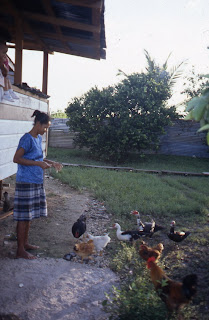 As I mentioned last week, the family raises their own fowl, as do many Trinis. Irene is scattering a little bit of feed so she can catch a duck to sell to our friend Joy. Irene would gladly curry the duck on the spot but we'd like to make sure she can afford to replace the duck we will eat tonight so we negotiate a price.
 Irene ties the legs of the duck she caught. What the picture can't even begin to capture was the mad chase around the yard, under the house, behind the foundation, with 4 or 5 kids and 3 adults in hot pursuit of one terrified duck.
 The exchange is made and the duck's time wanes. In a couple hours it will go from wandering around Irene's yard to plucked, gutted, and curried in Joy's kitchen. I don't know if it is still the case but when we lived in Trinidad a common sign advertising good places to get a chicken or duck for your Sunday dinner was "PLUCKING AND GUTTING SATURDAYS." You'd go out, point to the bird in the yard that you wanted and pay for it. After the deal you'd head to the produce market to get your vegetables and fresh seasonings. On the way home you'd stop by the pluck-n-gut and be handed a still warm but fresh bird carcass ready for stewing or currying for your Sunday dinner. Yes, you could get chickens and parts at a supermarket but a lot of people still preferred this because they knew the bird was as fresh as could be. In the tropics that is a fairly important consideration.
 Before we leave, we snap a quick picture of Irene and 4 of her 7 children. They are a wonderful family and special friends. Again, they are posing on the foundation for what they originally intended as a new, more secure house. Joy has spoken on several occasions of wanting to hold regular classes in the village in order to reach more of the children who can't get to school regularly. We can only transport so many ourselves and understandably, many parents don't want young children taking taxis. Giving an allotment for taxi fare doesn't mean it will be used for such. Remember there are a lot of hard choices to be made daily between taxi fare, food, and clothes. Joy has been looking for a good place to locate the school program. Irene and Mathura have offered the use of the foundation for a building to be used by Joy. They very much want their own children and the other children of the village to get good schooling. They see it as a win-win situation. Joy would compensate them for the foundation already built so they could continue to work toward having a better home. The school would be available to the rest of the village. The problem rests with maintaining security since having a "school" with valuables inside could expose the Mathuras to greater risk from bandits.
The other issue no one has really discussed is that as squatters they don't own the rights to the land and later in this same year the government will push to relocate everyone in this village. You may think this is an improvement but no one in the village sees it as such. Their homes may be somewhat crude by our standards but they were built by their inhabitants. The people dug their own gardens. They formed a sense of community. The place the government wants to relocate them to is a sterile piece of rock where nothing grows. Let me tell you finding any place that is less than lush with vegetation in Trinidad is a real challenge. The government had to search long and hard to come up with that sad lot. The houses are concrete ovens which all but bake their inhabitants alive due to the way they retain the sun's heat. I had the opportunity to respond personally to the Prime Minister's wife over this issue. It's when Joy told me I had real belly. (Go ahead, you know you want to read about me telling her off...nicely...)
My visit on this trip was 14 years ago. Ten years ago the village still stood.
 As soon as some of the neighbors who know us well recognize us they come running. Innocenta is glad to see us and fetches a couple of coconuts from her tree so she can share with us all. she might not have sweet drink to offer us but in the hot Trini sun the water from a nut is more refreshing. A bit of coconut trivia: coconut water is a naturally rehydrating drink of superior quality to Gatorade of Pedialyte or anything commercial. It has also been used in place of blood plasma. Amazing, no?
 Ok, back to the visit. Mathura adds a couple of his own coconuts to the mix. Most often folks drink the water right from the nut but since we have more people than nuts he is opening them and pouring them into a pitcher so we can share. The concrete slab he's using is the foundation he poured for a block house. Currently the family is in a wooden house but security in a wooden house is always a bit of a challenge. Little by little he's working toward a better future for his family.
 After all the coconut water is gone it's a treat to split the nut in half and scoop out the soft white jelly from inside. I have to admit that's my favorite part. I like it much better than the way most Americans eat coconut which is to wait until it's dry and brown and then flake up the hard meat inside. Gimme the jelly from a green nut any day. Usually you just chip off a sliver of the husk to use as a spoon but Irene and Mathura's little girl is happy with a real spoon.
 As I mentioned last week, the family raises their own fowl, as do many Trinis. Irene is scattering a little bit of feed so she can catch a duck to sell to our friend Joy. Irene would gladly curry the duck on the spot but we'd like to make sure she can afford to replace the duck we will eat tonight so we negotiate a price.
 Irene ties the legs of the duck she caught. What the picture can't even begin to capture was the mad chase around the yard, under the house, behind the foundation, with 4 or 5 kids and 3 adults in hot pursuit of one terrified duck.
 The exchange is made and the duck's time wanes. In a couple hours it will go from wandering around Irene's yard to plucked, gutted, and curried in Joy's kitchen. I don't know if it is still the case but when we lived in Trinidad a common sign advertising good places to get a chicken or duck for your Sunday dinner was "PLUCKING AND GUTTING SATURDAYS." You'd go out, point to the bird in the yard that you wanted and pay for it. After the deal you'd head to the produce market to get your vegetables and fresh seasonings. On the way home you'd stop by the pluck-n-gut and be handed a still warm but fresh bird carcass ready for stewing or currying for your Sunday dinner. Yes, you could get chickens and parts at a supermarket but a lot of people still preferred this because they knew the bird was as fresh as could be. In the tropics that is a fairly important consideration.
 Before we leave, we snap a quick picture of Irene and 4 of her 7 children. They are a wonderful family and special friends. Again, they are posing on the foundation for what they originally intended as a new, more secure house. Joy has spoken on several occasions of wanting to hold regular classes in the village in order to reach more of the children who can't get to school regularly. We can only transport so many ourselves and understandably, many parents don't want young children taking taxis. Giving an allotment for taxi fare doesn't mean it will be used for such. Remember there are a lot of hard choices to be made daily between taxi fare, food, and clothes. Joy has been looking for a good place to locate the school program. Irene and Mathura have offered the use of the foundation for a building to be used by Joy. They very much want their own children and the other children of the village to get good schooling. They see it as a win-win situation. Joy would compensate them for the foundation already built so they could continue to work toward having a better home. The school would be available to the rest of the village. The problem rests with maintaining security since having a "school" with valuables inside could expose the Mathuras to greater risk from bandits.
The other issue no one has really discussed is that as squatters they don't own the rights to the land and later in this same year the government will push to relocate everyone in this village. You may think this is an improvement but no one in the village sees it as such. Their homes may be somewhat crude by our standards but they were built by their inhabitants. The people dug their own gardens. They formed a sense of community. The place the government wants to relocate them to is a sterile piece of rock where nothing grows. Let me tell you finding any place that is less than lush with vegetation in Trinidad is a real challenge. The government had to search long and hard to come up with that sad lot. The houses are concrete ovens which all but bake their inhabitants alive due to the way they retain the sun's heat. I had the opportunity to respond personally to the Prime Minister's wife over this issue. It's when Joy told me I had real belly. (Go ahead, you know you want to read about me telling her off...nicely...)
My visit on this trip was 14 years ago. Ten years ago the village still stood.
Monday, January 25, 2010
Down the Road in Trinidad
Long time readers of this blog know I did a regular feature called Trini Tuesday for the first year and a half I was blogging. Many of you are more recent readers and may not even know I lived in Trinidad for a little over a year. In fact, Calypso was born there. This weekend I visited my mom and since she has recently acquired a scanner which adapts to scan slide film I took a pile of slides down to convert into digital format. It's been forever since I got to look at some of these and they really provoked a lot of memories. I thought I'd share a few today.
For the sake of clarity, what you will see here is not representative of how most folks in Trinidad live but it is a level of poverty which is not at all difficult to find on the island. We lived in a middle class neighborhood in a concrete block house with electricity and running water (but no hot water heater). We found out the hard way it is not at all safe for Americans to live elsewhere. Many of the folks we worked with were squatters though. They had built their homes out of whatever scrap materials they could find or bought bits of lumber here and there as they could afford. They had no running water in the houses. Any electricity they had came from the ingenious use of car batteries, if they could afford a battery.
Join me for a trip out to the village to visit some friends.
 Follow the highway out of one of the cities until the buildings become sparser and the vegetation denser. Turn off the highway onto a still paved road and find the water standpipe with a dirt road by it. No one out here owns a car so the road only has to be decent enough to walk. You can park yours at that first house on the left since you know the family and the road really isn't fit to drive down much farther. We'll stop and lime here a while before we head further in to the village.
 No, the driving age in Trinidad isn't quite this young but Calypso was having fun climbing around once we parked.
 Here's a little perspective on the house. Yes, it's leaning pretty heavily. It's built up on stilts to prevent flooding during rainy season. Farida and her six children moved here after her husband left them. She also shares it with her current partner. He disappears for long periods of time so when something needs repairing Farida needs to see if she can scare up the supplies and borrow some tools to fix things up as best she can. It may not look like much but Farida is proud of it and keeps it neat as a pin inside. The local paint companies give out free paint (the stuff not good enough to sell) near Christmas. She makes sure to get some so she can repaint each year. She also stitches up the holes in the furniture and sews new curtains if she can get some fabric. When you are 11 degrees above the equator the sun takes a fast toll on paint and curtain fabric. The front room is a kitchen and living room. The back is a bedroom with two mattresses. Sleeping quarters are tight. Privacy is barely existent. Without electricity there are no fans to run at night for relief and to blow the mosquitoes off you. You've got to shutter up those windows each night to keep bandits from coming in to steal what few things you have. You'd better hope you can afford a mosquito net and then keep it from ripping. The outhouse is in the back. Fortunately, since their house is closest to the road they have the shortest walk to the standpipe for water. Farida and the girls also like to keep the landscaping as nice as they can. You can see the trimmed hibiscus lining the walk to the front door.
 This is one of Farida's daughters. Her daughters are beautiful and smart. Farida worries about their opportunities for education because of the cost of textbooks, uniforms and passage to school. One of the girls needs glasses too. She's probably the most promising student among the sisters but gets headaches when she reads. Taxis cost so much because they are so far on the outskirts of town. In this village it's a pretty common state to have to choose between buying food and paying taxi fare for your kids to get to school. Sometimes in big families, if they don't have enough school uniforms the children take turns going to school. One wears the uniform one day then the next day another child wears the uniform. No matter how smart you are it's hard to get ahead when you can't get to school regularly or afford your textbooks or concentrate through blurry vision or a hungry stomach when you do read them.

Before we go we take a picture of everyone who is home because we know it will be a long time before we get back this way again. We can't believe the way everyone has grown. A few years later when we went back the younger 2 kids were in school. Farida cried with joy to tell us her three oldest girls had finished school, had jobs, and were living in an apartment with electricity and running water. She was also very grateful they were helping with taxi fare, books, and uniforms for their younger siblings. Farida intends never to leave her house but she can't contain her happiness over the children who made it out of the village.
For the sake of clarity, what you will see here is not representative of how most folks in Trinidad live but it is a level of poverty which is not at all difficult to find on the island. We lived in a middle class neighborhood in a concrete block house with electricity and running water (but no hot water heater). We found out the hard way it is not at all safe for Americans to live elsewhere. Many of the folks we worked with were squatters though. They had built their homes out of whatever scrap materials they could find or bought bits of lumber here and there as they could afford. They had no running water in the houses. Any electricity they had came from the ingenious use of car batteries, if they could afford a battery.
Join me for a trip out to the village to visit some friends.
 Follow the highway out of one of the cities until the buildings become sparser and the vegetation denser. Turn off the highway onto a still paved road and find the water standpipe with a dirt road by it. No one out here owns a car so the road only has to be decent enough to walk. You can park yours at that first house on the left since you know the family and the road really isn't fit to drive down much farther. We'll stop and lime here a while before we head further in to the village.
 No, the driving age in Trinidad isn't quite this young but Calypso was having fun climbing around once we parked.
 Here's a little perspective on the house. Yes, it's leaning pretty heavily. It's built up on stilts to prevent flooding during rainy season. Farida and her six children moved here after her husband left them. She also shares it with her current partner. He disappears for long periods of time so when something needs repairing Farida needs to see if she can scare up the supplies and borrow some tools to fix things up as best she can. It may not look like much but Farida is proud of it and keeps it neat as a pin inside. The local paint companies give out free paint (the stuff not good enough to sell) near Christmas. She makes sure to get some so she can repaint each year. She also stitches up the holes in the furniture and sews new curtains if she can get some fabric. When you are 11 degrees above the equator the sun takes a fast toll on paint and curtain fabric. The front room is a kitchen and living room. The back is a bedroom with two mattresses. Sleeping quarters are tight. Privacy is barely existent. Without electricity there are no fans to run at night for relief and to blow the mosquitoes off you. You've got to shutter up those windows each night to keep bandits from coming in to steal what few things you have. You'd better hope you can afford a mosquito net and then keep it from ripping. The outhouse is in the back. Fortunately, since their house is closest to the road they have the shortest walk to the standpipe for water. Farida and the girls also like to keep the landscaping as nice as they can. You can see the trimmed hibiscus lining the walk to the front door.
 This is one of Farida's daughters. Her daughters are beautiful and smart. Farida worries about their opportunities for education because of the cost of textbooks, uniforms and passage to school. One of the girls needs glasses too. She's probably the most promising student among the sisters but gets headaches when she reads. Taxis cost so much because they are so far on the outskirts of town. In this village it's a pretty common state to have to choose between buying food and paying taxi fare for your kids to get to school. Sometimes in big families, if they don't have enough school uniforms the children take turns going to school. One wears the uniform one day then the next day another child wears the uniform. No matter how smart you are it's hard to get ahead when you can't get to school regularly or afford your textbooks or concentrate through blurry vision or a hungry stomach when you do read them.
Before we go we take a picture of everyone who is home because we know it will be a long time before we get back this way again. We can't believe the way everyone has grown. A few years later when we went back the younger 2 kids were in school. Farida cried with joy to tell us her three oldest girls had finished school, had jobs, and were living in an apartment with electricity and running water. She was also very grateful they were helping with taxi fare, books, and uniforms for their younger siblings. Farida intends never to leave her house but she can't contain her happiness over the children who made it out of the village.
Subscribe to:
Posts (Atom)