As I mentioned, Mr. Lime, the girls, and I went to Philadelphia Sunday rather than watching the SuperDuperBowl. First stop was a brief (3 hours rather than 7) to the Art Museum. I found this Medieval German vise with a rather clenched look about it. I found that quite amusing in spite of the less than pleasant expression. Who said Germans are humorless?
We each have different taste in art but this piece by Edward Redfield was one we all agreed upon as one we enjoyed. Similarly we all agreed the weird painting of a crowd of naked toddlers romping in a river was just bizarre. I wish I had taken a picture of that to show you all.
After wandering around the art museum we worked up a good bit of hunger so we headed to south Philly to the famous Pat's for a cheesesteak. As you can see right across the road is their competitor, Geno's. I suggested we get half our order from one and half from the other then compare the two to see which was favored. Extreme hunger drove the family to open revolt over the idea of research so Pat's it was.
My review: they screwed up my order in spite of my correct ordering technique, 2 wiz wit, 1 provolone witout,
1 american witout, (it's not unlike Seinfeld's soup Nazi episode...you
order correctly, with cash in hand or get sent to the end of the line). The cheesesteak was tasty but for $9.50 it seemed pretty skimpy. The fries, however, were worth every cent. No there are no fries in this picture. I ordered them after snarfing down my "wiz wit(out)"
After filling our bellies we moved on to the Edgar Allen Poe National Historic Site. Who knew Philadelphia would be home to this part of the National Park System. Poe was born in Boston, spent 5 years in England as a child, died in Baltimore, and spent a 6 years in Philadelphia...a single year of which was spent in this particular house, which he rented for the $100 (for the year) after winning a writing contest for the same amount. There was nothing in the rooms except stripped down plaster walls with a single picture in each....oh, and one room had this stuffed monkey in the closet. I have absolutely no idea why. Why not?
In a room that was formerly part of the Poe's neighbor's house things were set up to resemble a Victorian reading room. We listened to a recording of Christopher Walken reading The Raven. It was terrifying....as you can see,
We covered art, then literary works, no we moved on to history. This should need no explanation. What you may not know is that the Liberty Bell was melted down and recast more than once. Also, that large crack is not the original one. The first crack is visible to the naked eye but looks more like a hairline fracture than a gaping fault line. When I was a kid the Liberty Bell was housed under an open pavilion. I was poorly lit but you could walk up to it and touch it. I can recall doing so as a kid on a field trip. Now it is in a nice visitor center inside where it is necessary to go through a search of one's bags and one's person (repeated when entering the Independence Hall complex) I called it pirouetting through history since we were told to lift out jackets and spin around. I wanted to ask for music....at least some tinny rendition of Swan Lake like might be in a six year old's musical jewelry box. Touching the bell no? Nope, that's right out! but it is well lit with ample natural light.
Again we submitted to the search to enter the Independence Hall complex which includes Old City Hall (which is where the Supreme Court sat while Washington, DC was being built), Independence Hall, and Congress Hall. This is designated as a World Heritage Site. I am not exaggerating when I say I believe every US citizen should try to visit this place at least once if at all possible.
The Rising Sun Chair where John Hancock sat.
Inside the signing hall on the first floor.
View from the third floor Long Room through the hallway and out the back window.
If a woman over 40 doesn't want to watch the game, she doesn't sit around whining about it. She does something she wants to do and it's usually something more interesting. ~Frank Kaiser In Praise of Older Women
As I said yesterday, I found alternate activities for game day. I was visiting my parents for the weekend and took Sunday afternoon for myself. I've posted in the past about how I find cemeteries calming places (here and here). Since I was close enough I decided to go visit my grandparents' graves. Though I like to see old headstones that actually stick up from the ground my grandparents are buried in a more modern cemetery where all the markers are flush to the ground. It's a pretty large place but fortunately both sets of grands are in the same section. The funny thing is my paternal grandparents are "neighbors" to the folks who were their next door neighbors for nearly 50 years. I had a little trouble finding one set of grandparents but in the process I stumbled over my great-great grands. I said hello since I was there. The weather was so mild and sunny. It was a nice, peaceful stroll in a quiet place.
Back of the mansion with 2 additions
After a little visit there I went to a local historical site. It's the Colonial mansion of the town founder whose family was deeply intertwined with my dad's forefathers (who founded the first iron works in our state). For a very minimal donation I was given a private tour of the place since it was not at all busy. I was a little disappointed that even non-flash photography was not permitted inside the building (so you'll have to live with outdoor shots that don't correspond to what I'm talking about) but the tour was quite informative and interesting.
Front of the mansion
For years, I've been involved in a 19th century living historical farm where I currently live. That setting is far more rural, involves the Pennsylvania German subculture, and was peopled by common folk. The Colonial mansion was inhabited by the Donald Trump of the day, who was an English colonist. Even though the mansion was a century older than the farm where I help I was surprised by how much more advanced some of the technology seemed to be. The differences privilege makes even with the great time lapse were notable. The most interesting bit of technology, which I had never seen before, was a clock jack. This gadget employed a weight and system of pulleys to turn a large spit in order to roast cuts of meat large enough to feed a couple dozen people without having to remain hearth side for the duration of cooking. The complexity of the the mechanism and the cost associated with producing or repairing it kept it out of the economic reach of most folks. Then again the common folk weren't necessarily cooking to feed 20-30 people at a time either.
The part of the tour that made me laugh hardest was when the guide pointed out how a table in the parlor was set for a colonial drinking game that makes beer pong look completely wimpy. A large bowl was filled with spirits into which raisins and almonds were added. The alcohol was lit and party-goers had to reach in and grab as many raisins and nuts as they could....you know...without setting themselves on fire. Those crazy colonials!
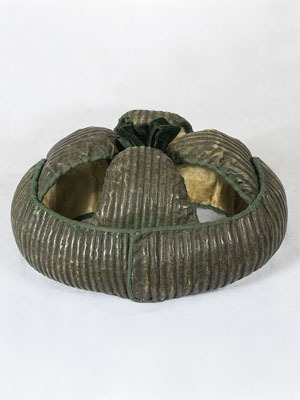
Another interesting item I learned about was pudding caps. No, it wasn't some weird drinking game or even an eccentric beauty treatment whereby colonial women conditioned their hair with glops of pudding. Pudding caps were padded hats worn by toddlers to protect them from knocking their noggin too hard, thus turning them into pudding headed dolts. You can see a picture of one here.
All in all it was a peaceful day with beautiful weather. I had time for some reflection and education and I was content to do my exploring alone. That beats football by a country mile any day of the week.
Another activity Mom and I enjoyed this weekend was heading out to a local folk festival. It's one I've wanted to go to for a few years since it's at a living history site like the one where I have volunteered. Both this one and the one I am familiar with highlight Pennsylvania German culture. The one near to me covers early 19th century whereas the one I visited this weekend covers the Colonial period. It was really interesting to note some of the differences and similarities.
Here we have an example of bobbin lace making. It looks quite complex but the lady demonstrating demystified the process considerably. It's still painstaking though.
This is a butter mold. These were used not just as decoration but as a way to "brand" a local farm's butter so it was recognizable in the market.
Just a corner of a house that intrigued me.
This is the dining table in the same house.
In the house, which was quite dimly lit, there was a demonstration of hearth cooking. This is not the best picture I've ever taken since I wanted to try capturing the scene without resorting to using flash. It meant using a slow shutter speed and trying to control camera shake without a tripod or even a sturdy surface to rest the camera on. I found out there's an application for marksmanship skills in this. Hold your breath, squeeze the trigger slowly and smoothly...or the shutter release as the case may be.
A row of planes at the carpenter's section of the festival.
A powder horn that was typical to this particular area. Most of the other decorated powder horns were decorated with scrimshaw. This one was etched with a mildly acidic solution rather than carved and inked. I quite liked it.
I've always loved the stone farm houses that dot the area where I grew up so I had to get a shot of some stone work.
One of the things I enjoy about the Olympics aside from watching the competitions is hearing the various national anthems during the awarding of medals. I like watching to see the reactions of the gold medalists when they hear their anthem and I like hearing what the respective anthems sound like. I stayed up late to see the ice dancing medals given and really enjoyed watching the Canadian winners sing along with the entire crowd to O, Canada. And if you haven't heard me comment on curling enough, I also loved the story about how the Canadian crowd urged on the curling team by breaking out into the anthem as well. You Cannucks have a much nicer anthem than we Yanks do.
It's true, I don't like the Star Spangled Banner. Call me a crank or question my patriotism but it's horrible to try to sing it because it's all over the place. The lyrics focus on one battle in one war and give an extremely limited scope as to the values Americans hold dear. Personally, I prefer Amercia the Beautiful because it celebrates a broader range of our history and cultural values within a more singable range of notes. In any event, the title of this post is Trini Tuesday so for today I'm again rerunning a very old post about the anthem of Trinidad and Tobago. It has a dignity befitting an anthem and it sounds lovely whether played by an orchestra or on steel pans. You won't hear it at the Winter Olympics but in case you wondered they've won medals in the Summer Games.
For now, you can click on the video and just listen as you read. I'll share a few thoughts on the lyrics below.
Forged from the love of liberty, In the fires of hope and prayer, With boundless faith in our Destiny, We solemnly declare, Side by side we stand, Islands of the blue Caribbean Sea, This our Native Land, We pledge our lives to Thee, Here every creed and race finds an equal place, And may God bless our Nation, Here every creed and race finds an equal place, And may God bless our Nation.
Patrick S. Castagne composed the words and music of the National Anthem in 1962.
Forged from the love of liberty, in the fires of hope and prayer... Trinidad and Tobago was alternately controlled by Spain, France, and Britain. It is one of the few Caribbean islands which still has a small enclave of indigenous people. It is very small, and there are none with 100% Carib or Arawak blood, but a group still exists and there is deep pride in what culture remains. The bulk of the nation's population, roughly 80-85%, is descended from African slaves and the East Indian indentured servants that were brought to replace the slave labor lost upon emancipation. Entire villages from southern India were transplanted to Trinidad with promises of freedom once the cost of passage was worked off. These are a people with a collective history of oppression yet who maintained an indomitable spirit. Independence was gained on August 31, 1962. It is really quite a thing to sit and listen to the stories from 1962 when they are told by someone who was there for such a moment in history. It was a bloodless handover of power unlike our own revolution but the excitement over the right to determine the path of one's own nation still carried great impact.
With boundless faith...side by side we stand. While Trinis may be quick to criticise government and perhaps lack faith in their leaders every bit as much as we do or more, they still know that without unity they are doomed. When times get bad they pull together, neighbor stands with neighbor. A sense of community exists that is a great strength in the culture. We were the recipients of such warmth and generosity on many occasions. We lived at the very end of the water pipelines, as such we were the last in the neighborhood to get water. Water does not flow into houses around the clock so tanks are the norm for storing water to use throughout the day. At the end of dry season our water tanks were empty even though our neighbors had begun getting enough pressure to fill their tanks. As soon as neighbors realized our predicament every hose in the neighborhood was running from 3 different neighbor's houses to fill our tank. We didn't ask for it. They asked us, "Do you have water yet?" When we said no they flew into immediate action. People look out for each other and lend practical assistance not just words of encouragement.
Here every creed and race finds an equal place. In addition to the Africans and East Indians there are significant Chinese, Portuguese, and Syrian minorities as well as the odd Brit, American, or immigrant from other Caribbean nations. Religiously, you'll find large populations of Catholics, Anglicans, Hindus, Muslims, and the syncretic Spiritual Baptists who blend a little bit of everything. One set of neighbors was representative of most of this. The father was a practicing Muslim, the mother an observant Hindu, the children were sent to Catholic school. Religion is not a forbidden topic of conversation, neither is it generally a thing that causes heated debate when discussed. True to Trini love of liming, more religions and cultures means more opportunities for a day of work to party. Whether it is true or not, I don't know, but Trinis like to boast that they have more public holidays than any other nation on earth because each culture and religion is represented in at least one official holiday. It's not at all unusual for folks of widely differing spiritual practices to share each other's holidays. Racial terms are bandied about very casually, but again, not in a derogatory manner. Because of the intermingling of races there is a descriptive term for just about every mixture. When you meet someone new an early question is going to be 'What's your mix?' I have to admit, I used to get a kick out of being ambiguous looking enough to confound them....Hhhmm, American accent, black hair, good tan......"Gyal, what yuh mix is? I cannuh figure yuh!" Is there occasional conflict based on religion or race? Yes, of course. But overall, there seems to be a really refreshing embracing of differences rather than mere tolerance.
When I was small my mother allowed me to use her old sewing machine once she replaced it with a new one. It was an old, blue Singer that was notorious for jamming. It drove me out of my mind. I had not yet developed skill so the least bit of resistance or malfunction tripped my frustration. Mom would happily sew away in her own little world and I'd want to throw the blue beast on the floor. I couldn't understand what on earth she enjoyed about sewing when all I ever got were tangles, knots, and a jammed machine. "Keep at it, don't give up, take your time. You're just a beginner. It will get easier." But I couldn't get past the frustration.
I could do basic repairs like sewing on buttons or fixing a seam by the time I entered Junior High when I had to take Home Economics. The teacher was a miserable woman who found out my mother was a seamstress and therefore expected perfection from me. This did nothing to endear me to the art of sewing. Mom got me through that class with her gentle patience and encouragement...as well as the secret agreement that my teacher was in fact being a completely nit-picky twit. In the meantime, I picked up crocheting from my grandmother. I did graduate high school knowing how to read a pattern and construct a basic garment, nothing too fancy or tailored very precisely though and it had to have explicit instruction from which I would not dream of deviating.
In college I picked up cross stitching and continued a little crocheting. I began to see how these sorts of things could be relaxing, contemplative, restoring, even meditative. I made a lot of gifts that way. Especially in college, in between reading, studying, and writing papers, it felt good to disengage the brain for a bit and focus on something else and yet have something to show for the time. I even went so far as to design some of my own pieces since I couldn't find patterns like what I wanted to do. Mom and Nana were delighted to see I'd found some sort of art involving needles and threads and that I enjoyed it and made it my own. They encouraged that and showed off my work to people they knew. I felt like I had accomplished some rite of passage.
Shortly after getting married I acquired a very old, very heavy, but very trusty sewing machine from our landlord. It had been his grandmother's and it seemed his fiancee turned up her nose at the old machine. I was delighted to receive it after giving it a try. It worked like a charm and had an external belt and other features that made maintenance easy. I could do repairs and minor alterations now without having to rely on mom's machine when we went to visit. I also had fun making just a few very simple outfits for Diana when she was a baby. Mom was thrilled to share some baby patterns with me and coach me along the way. Heavy as my machine was, I paid to ship it to Trinidad when we moved there.
Then in Trinidad I found I was pregnant with Calypso. Diana had been born in the middle of winter so most of my maternity clothes were winter-wear, which was much too heavy for the tropics. Off the rack maternity clothes were either hard to come by in Trinidad or extremely expensive. I had my mom send me some patterns and I set to work sewing since fabric there was very inexpensive. I had a couple of disasters and Mom was not close at hand to help me figure out how to fix them. It was just the machine and me. I ripped out mistakes and resewed new mistakes and jerry-rigged some I just couldn't cope with ripping again. I also had some nice successes. Mom wanted to hear all about it and see pictures. She laughed about my endless mistakes but commended me for figuring out how to make it work telling me that was a normal part of the process. I felt more confident. Then we were robbed and the thieves took my machine. We had a very high wall with broken bottle embedded in it. I will admit I prayed they all got a hernia or two trying to heft that machine over the wall.
When we came back to the US and Mr. Lime found a job, he got me a new sewing machine. It was a pretty basic model but it did what I needed it to do and has remained reliable. I continued to do repairs and minor alterations and the occasional item of clothes for the kids or me. Then came the challenge of costumes for the living history farm where the kids and I have volunteered. I was able to lay my hands on a basic pattern for the blouses and bonnets...VERY basic. Basic as in, "Here's a rough shape to cut out with a bunch of pieces but we aren't going to give you any directions as to how to assemble them. Oh, and for the skirt you're completely on your own. Here's a picture of how it should look." Yowza, I was just a wee tad nervous about this whole endeavor. Thankfully, I had some borrowed garments I could examine to see how they were constructed and I had a book that explained different techniques. I was thrilled when I managed to produce wearable, reasonably accurate costumes AND to have my mother tell me they were well-constructed. This is the woman who made my wedding gown, her gown, and all the gowns for my attendants, the woman who made my prom gown and Diana's, the woman who had been making quilts since before I was born (including one for me with scraps of my old baby clothes and kitchen curtains she had also made). This woman looked on my work, the work of a kid who used to scream and cry at the old blue beast sewing machine, and she pronounced it "very good."
So now I am working on this quilt for Diana. Mom and I worked together on the one I have on my bed but she did at least 85% of the work. I committed to make my first ever quilt from start to finish for Diana. Mom has advised me. She helped buy the fabric as a gift for Diana. Mom asked if I wanted her to help sew it or if I was determined to do the project myself. I told her it's my goal to do all the work myself on this one. It's the next rite of passage for the machine and me. She seemed to understand. The more I get to know my way around the machine the more accomplished I feel and the more I understand about Mom and the line of seamstresses, knitters, tatters, and quilters who came before her in our family.
This past week and weekend it's rained a lot so I have been catching up on this project because in three short weeks Diana heads off to school. The quilt needs to be done by then. In the process I am finding the stitches don't just bind fabric together. They are binding generations.
After my folks split up Dad moved to an old stone farmhouse his city-dwelling brother owned. Dad was more or less to be the caretaker of the buildings and property. It was one of the original farmhouses in that area, nestled in a snug valley like a pendant in an ample bosom. Up on one of the hills in the pasture was the family burial ground. There was a low, crumbling stone wall with chestnut trees at the 4 corners. Inside were the limestone grave markers going back as early as Colonial days. Several were in German. Many were worn beyond readability. Many times during visits with Dad I'd hike up the hill to sit in the shade of the trees or look at the old stones as I wondered about the people who rested there. It was my thinking place, my dreaming place, my listening place. I will admit to having a very overactive imagination as a young kid so as Halloween approached my visits became less frequent. I was afraid perhaps the dead might rise and carry me back to darkness with them. Once the dangerous date had passed though I'd resume my trips to the quiet place to imagine the lives of the people resting there.
When I was a little older my grandfather took my brother and me on a field trip of sorts. It was an unusual thing for him to have us by himself and I can't recall the circumstances leading to that arrangement but I do remember the day. He said he wanted to take us to a couple of cemeteries to meet some relatives. My brother and I must have looked a little shocked because Pop-pop asked us if it was going to give us bad dreams. He was well aware of my overactive imagination and how hard it sometimes was for me to shut it off at night. I told him I'd be fine. I understood this was an important day. We spent the afternoon going from graveyard to graveyard. Pop-pop never had to look very hard to find the headstones he wanted. I think he visited often. At each one we'd pause in a few moments of silence before the stories began. Pop-pop would tell us who each person was, how they were related. He'd tell us a bit about the person's character and then give the most memorable stories from their lives. I knew it was a solemn day of acquainting us with his side of the family who we could only know in this way. It wouldn't be until years later that I appreciated the depth of those moments. I have wished many times I had been able to make that trip with him again as a grown person. So yes, I've had a bit of a thing for old cemeteries for a long time.
My trip to Boston motivated me to finally get myself to one of the original cemeteries in my own town. The old Moravian cemetery is the resting place of the town founders. I've been meaning to pay them a visit for a long time but just never had since they are not located in an area of town that is a place where one usually parks and walks around. It's a thoroughfare where busy cars speed past. Friday night I stopped.
The first thing I noticed was the way the tree by the gate beckons you inside if you walk past rather than speed by in a car.
One of the first headstones I found was Susana's with a poetic epitaph at the bottom. I can't read the first line but the last 3 read, "She was our joy and pride. We loved her ah perhaps too well. For soon she slept and died."
Nearby was this headstone. Certainly such sadness was more common a couple hundred years ago but it's never the natural order of things for a parent to outlive a child. I said a prayer for those folks I know personally who have endured this pain.
Here we have John Brown who apparently lived to a ripe old age. 1746-1827. This was the stone with the earliest dates that I found or was able to read. I took note that the flag holder marks him as a Revolutionary War veteran.
Several of the stones seemed to have this flower carving on them. This was the one which still had the clearest image. So many were terribly eroded.
This was the most ornate headstone I saw. I wondered if Mary was a woman of refined tastes or just so beloved that her family wanted her marker adorned like this.
I strolled among so many more stones which were too worn to read. Some were large, others very small. Some were broken. As you see with Mary's, some were quite ornate. There was also a section of very rough cut stone. I was intrigued by how simple and small they were. H.A. Lee's was less than a foot tall.
Finally, as the sun set, I left the graveyard. I thanked the occupants for providing me a quiet place to think. I thought perhaps I heard a whispered a thank you for the visit. The trees standing guard waved me on my way.
Sunday after the food show Jacob had a birthday party to attend. Lisa offered to drop me off wherever I wanted and let me explore the city alone. I asked her to take me to Boston Common and I decided to hike most of the Freedom Trail which leads visitors to various historical sites around the city. The last time I walked the Freedom Trail was when I was pregnant with Diana. It was a hot summer day and there was a noticeable dearth of public restrooms. Although the company I had was pleasant the heat and constantly overfilling bladder made it less than delightful. This time I enjoyed a solo trek through the city and a brisk early Spring afternoon. It was far more relaxing and offered a peaceful time to wander with my feet and my thoughts. Today my count is mostly pictorial just to show you the city through my camera lens. The first two are actually from the day before at Castle Island but I was pleased with the results. Many of the pictures from various buildings are at odd angles or of specific details because some spaces are too tight to back up and get a full shot or else there were so many cars or other distractions that I felt would take away from the picture. It was kind of an interesting challenge.
This just struck me a humorous. I can't help but laugh when a statue has a pigeon on its head.
I love checking out different architectural details.
Park Street Church where abolitionist William Lloyd Garrison gave his first anti-slavery address.
Granary Burial Ground. Paul Revere is buried here as well as the 5 victims of the Boston Massacre. This marker was a little different and a bit more macabre than the ones I saw last year. It intrigued me.
King's Chapel. Built in 1688 on orders by King James II as an Anglican church, a Georgian chapel was later constructed around the original wooden building. Later it became the first Unitarian church in the U.S. I just loved the ironwork.
Old South Meeting House. It was used for public meetings and was the site for many events leading up to the Revolution. During their occupation, the British used it as a stable and hacked its furnishings into firewood. This picture also displays some of what intrigues me about Boston, the way old and new nestle into the city side by side.
Old State House Museum is the oldest public building in Boston. It is in front of the balcony supported by this brace that the Boston Massacre happened.
Old State House
Faneuil Hall was a meeting place and open market. Opposition to British authority grew from the seeds sown during impassioned speeches given here. After independence the abolitionist, women's rights, and temperance movements found audiences in Faneuil Hall.
Another example of old meeting new. On the right is the Bell in Hand Tavern which was established in 1795. On the left is another old tavern where some important historical figures presumably found liquid courage. I forget the name of the place and who sought solace there. I was too busy ambling around thinking and occasionally snapping pictures. The other historical tidbits I am taking out of the $3 tour map I bought. I sound like I know what I am talking about don't I?
Old North Church. It was from this steeple that the two lanterns signaling Paul Revere's ride were displayed. I didn't need the $3 guide to tell me that. I arrived here as dusk was falling and pondered how that beacon must have shown without all the other tall buildings around. Cobb's Hill Burying Ground was locked so there was to be no twilight ambling through that cemetery. The next sites were across the river in Cambridge. I decided perhaps it was time to head back home but thankful for the chance to wander the city and ponder its history. I am very much of the opinion that every American, if at all possible, should make a trip to both Philadelphia and Boston simply for the historical value of those places. I'm grateful I've had the chance to do so.
I-93 bridge. Sun was setting as I left the Freedom Trail to find the nearest T station to take the train back to my cousin's. I stepped out of historic Boston and back into the modern world, which does have it's own interest.
DA COUNT (counting the good things we have instead of bemoaning the things we lack)
I'm recycling that Friday 55 from about a year and a half ago but my count for this week is new. My mother's side of the family has been good about making sure there is a genealogy that is kept current. However, it's been kept practically under lock and key with one or two individuals. One of the caretakers misplaced a significant chunk of her copy of the records. There are family recipes which have been handed down to the one or two cousins who specialize in a particular dish, while other recipes have been lost. There are family stories which are retold at each gathering and others that come as a surprise when they are shared, although it was assumed everyone knew the tale. There are old photographs which are cherished by those who hold them and coveted by those who lack them.
In the last couple of years the family matriarch has taken up writing. She has been reluctant to share her stories with people because her sisters looked down their noses at her efforts. She showed my brother, who is a published author, and he gave her words of encouragement. She has ventured out tentatively to show a few others one at a time. This past Christmas I was brought into that circle. I was delighted and honored. It is interesting to note she has chosen mostly the cousins in my age group. We have all encouraged her to write more and continue sharing. She said with some embarrassment that her sisters thought it was a waste of time. I told her to ignore them and write for herself and for the generation who is hungry for her words. She beamed....and within a week I had two stories in my mailbox.
This week one of my younger cousins sent out a mass email to the family requesting whatever genealogical information they have so he can plug it into some good software and make it available to all of us electronically. I responded quickly telling him how happy I was that he was doing this. We discussed photos and recipes back and forth and I agreed to try to collate as many family recipes as people were willing to share. I'm really excited about this effort.
Quite some time ago, Lecram gave me two domain names. I regret to say they have been dormant since he so generously bestowed them upon me. I will eventually move this blog to one of them. The other I am planning to give over to my family so we can move our genealogy, recipes, photos, and stories into the digital age so everyone has easy access to whatever they want.
This week I am counting another cousin's vision to do something combining with mine and Lecram's gift which can facilitate that.
Much is being made of the history making inauguration of Barack Obama, our first African-American President. It certainly is a momentous occasion. Here are some other, less momentous presidential firsts.
Ulysses S. Grant was the first to run against a woman. His opponent was Victoria Woodhull, a former prostitute who was the nominee of the Equal Rights Party.
Abraham Lincoln was the first to receive a patent.
Millard Filmore was the first to have a stepmother.
Herbert Hoover was the first millionaire and the first to have a telephone on his desk.
FDR was the first to appear on TV and made the first Presidential flight.
Jimmy Carter was the first born in a hospital.
Benjamin Harrison was the first to attend a baseball game.
William Harrison was the first to die in office.
Martin Van Buren was the first who was born as a US citizen. He was also the first president born after the signing of the Declaration of Independence.
Richard Nixon was the first to visit all 50 states.
Teddy Roosevelt was the first to travel abroad while in office.
John Quincy Adams was the first to reach the office of President without winning the popular vote. He was also the first son of a former president to ascend to the office.
Warren Harding was the first to ride to his inauguration in an automobile and the first to speak on the radio.
*Information from biography.com, nationalgeographic.com, and enarta.msn.com
Here is one more of the quilts that was found in my grandmother's cedar chest. I am not in possession of this one, which is a crazy quilt. My stepmother held onto it because it is her favorite. I have always been fond of crazy quilts myself. I did take a picture of it though so I could share with you all and so I could ask my mom what she knew about it. Mom seems to think the crazy quilt was more related to my grandfather than my grandmother. She believes it was either given to him by his grandmother or possibly by his mother-in-law. I'm going to have to do a bit more investigation into that because my stepmother had it appraised many years ago and the appraiser seemed to think this quilt was produced in the 1940s, at which point I believe Pop-pop's grandmother was already dead.
In any event, let me give you a little information on crazy quilts in general. From what I have read, crazy quilting was a Victorian fad that generally combined fine fabrics such as silks, velvets, and brocades in asymmetrical, seemingly random patchwork patterns. The patches were sewn to a base fabric then embellished with ribbons, lace, buttons, or embroidered motifs. The borders of each patch were also stitched decoratively. No insulating batting layer was used between the front and back. On one quilt there could be several different patterns of these joining stitches. Early crazy quilts were often intended to be a decorative showpiece of the quilter's needle skills more than to be a functional bed covering providing warmth.
However, the one our family has is not a Victorian quilt. Later, it was more common to find rayon crazy quilts made with a batting and the quilts were tied through each patch. This allowed for warmth, and greater durability so the quilt could function as a useful bed covering. On our quilt there is still the haphazard patch placement and the decorative border stitches. There are also multiple thread colors in the border stitches but only one pattern used throughout the quilt. There is heft to our quilt and you can feel that there is a layer of batting that feels like either an old blanket or possibly a threadbare older quilt. Ours is less fancy and more utilitarian than the Victorian crazy quilts but I still love its wild splash of colors. I don't suppose that comes as a shock to any of you though.
For Diana's birthday my dad and stepmother gave her my grandmother's cedar chest. At that time I acquired most of the quilts which were stored inside the chest. I'm not entirely sure who made most of them but two that were inside I know my mother made. This first one I remember her working on. My grandmother was a cat lover. She always had a cat in the house. She also had a large collection of cat figurines. When my mom offered to make her a quilt she naturally wanted cats on it. In case there was any doubt that this was a quilt enjoyed by a cat lover, when I opened it up I found it covered in cat hair. I took a picture of it and immediately put it in the wash. Some of the old quilts I have I'd be afraid to wash but this one seems to have held up pretty well.
Here's a close up of one of the appliqued blocks. You can also see the hand quilting around the edge of the block and a little on the backing peeking out underneath where I folded it back.
Next is the quilt Mom made for my grandfather, who was a WW2 Navy vet. I only took this close up because it's unlikely the quilting would have shown up very well in a shot of the full quilt. The top is simply solid blue with most of it quilted in the anchor motif. The border is waves. The corner folded over shows the backing. I don't remember Mom working on this one but I do remember Pop-Pop tearing up when she gave it to him. Once he composed himself he talked with her about the techniques she used (he was fairly skilled with a needle himself) and praised her skill.
.jpg)
.jpg)
.jpg)
.jpg)
.jpg)
.jpg)
.jpg)
.jpg)
.jpg)
.jpg)
.jpg)


 *image from http://www.flickr.com/photos/brighterworlds/301705464/
 Here is one more of the quilts that was found in my grandmother's cedar chest. I am not in possession of this one, which is a crazy quilt. My stepmother held onto it because it is her favorite. I have always been fond of crazy quilts myself. I did take a picture of it though so I could share with you all and so I could ask my mom what she knew about it. Mom seems to think the crazy quilt was more related to my grandfather than my grandmother. She believes it was either given to him by his grandmother or possibly by his mother-in-law. I'm going to have to do a bit more investigation into that because my stepmother had it appraised many years ago and the appraiser seemed to think this quilt was produced in the 1940s, at which point I believe Pop-pop's grandmother was already dead.